

ABSTRACT:
There is no standardized treatment for multifragmentary fractures of the anterior
tibial tuberosity (ATT) in adult patients, with or without concomitant metaphyseal
fractures of the proximal tibia. This technical note aims to demonstrate the results
of using a minifragment plate positioned horizontally according to the tension band
principle in two patients with multifragmentary fractures of the ATT.
Palavras-chave: knee fractures; tibia; tibial plateau fractures.
RESUMO:
Não existe padronização de tratamento para as fraturas multifragmentares da tuberosidade
anterior da tíbia (TAT) nos pacientes adultos, com ou sem associação com fraturas
metafisárias da tíbia proximal. O objetivo desta nota técnica é demonstrar os resultados
da utilização da placa de minifragmentos colocada segundo o princípio da banda de
tensão, de forma horizontal, em dois pacientes portadores de fratura multifragmentar
da TAT.
Palavras-chave: fraturas do joelho; fraturas do planalto tibial; tíbia.
FIGURES
| Citation: Pires RE, Silva GW, Silva RC, Rosa EVF. Horizontal Tension-Band Plating: A New Strategy for Displaced and Multifragmentary Anterior Tibial Tuberosity Fractures Associated with Complex Metaphyseal Fractures. 61(3):. doi:10.1055/s-0046-1822833 |
| Note: Data Availability Data will be available upon request to the corresponding author. |
| Financial Support The authors confirm that they did not receive any financial support to conduct this study. |
|
Conflict of Interests
RESP declares having received payment for educational activities from Johnson & Johnson, Smith & Nephew, P&G, and AO Foundation. The other authors have no conflict of interests to declare. |
|
Editor-in-Chief:
Geraldo da Rocha Motta Filho |
| Received: January 31 2026; Accepted: March 31 2026 |
INTRODUCTION
High-energy proximal tibial fractures involving the anterior tibial tuberosity (ATT) represent a significant challenge in orthopedics due to their biomechanical complexity. These injuries often result from high-energy trauma and lead to multifragmentary fractures with extensive soft tissue involvement, further complicating clinical and surgical management.1–3 As the attachment site for the knee extensor mechanism, the ATT is subjected to intense biomechanical forces during muscle contraction. Due to the constant action of the extensor mechanism and the forces it generates, fractures involving the ATT—especially those that are displaced or multifragmentary—carry a high risk of fixation failure and may compromise fracture healing and functional recovery.1–3
The current literature is inconsistent regarding the optimal method for treating displaced ATT fractures. Treatment options include fixation with lag screws, either cannulated or noncannulated; combinations of plates and screws; conventional tension-band techniques; or reattachment of the patellar ligament to the tibia using anchors.4,5 However, there is no clear consensus on which approach offers greater mechanical stability and superior clinical outcomes, particularly in multifragmentary fractures, for which fixation with conventional methods is not feasible.
This technical note aims to analyze the effectiveness of surgical fixation using a minifragment plate positioned horizontally according to the tension band principle to maintain reduction and promote fracture healing in displaced ATT fractures in adult patients.
MATERIALS AND METHODS
This study included two adult patients with proximal metaphyseal tibial fractures characterized by ATT displacement and/or fragmentation. Cases were selected retrospectively based on medical records, outpatient clinical examinations, and radiographic findings. The study included patients from a tertiary hospital who underwent surgical fixation with a minifragment plate positioned horizontally according to the tension band principle. Follow-up continued until clinical and radiographic fracture healing (maximum of 1 year), assessed using serial conventional radiographs.
Ethical approval for article publication was granted under the CAAE 93952425.0.0000.5125.
Case Presentation
Patient 1
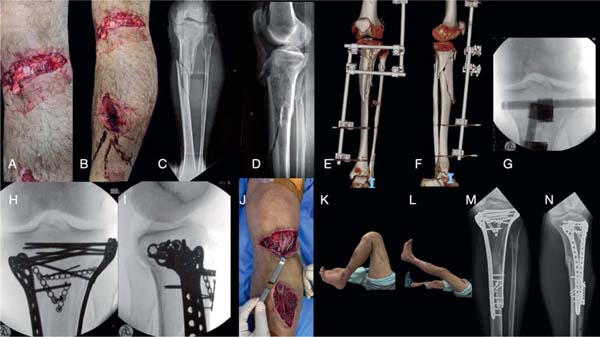
A 38-year-old male patient, a victim of a motorcycle accident, presented with an open fracture of the proximal region of the left leg, classified as Gustilo-Anderson type IIIA. At admission, two cutaneous wounds with bone exposure were observed at the fracture site, with no clinical signs of neurovascular compromise. The patient underwent urgent surgical management with debridement of devitalized tissues and transarticular external fixation for initial stabilization and local damage control.
After 3 days, a second surgical procedure was performed, including further debridement, removal of the external fixator, and conversion to definitive internal fixation. The fixation strategy combined two bridge plates (medial and lateral) for the metaphyseal component of the proximal tibia, minifragment plates for fragment-specific fixation, and a plate positioned horizontally for the multifragmentary ATT fracture. Because of the degree of comminution, the mini-fragment plate was passed within the patellar ligament (transtendon approach) to achieve greater fixation stability.
In the postoperative period, the distal leg wound was managed with negative pressure therapy, followed by skin grafting for definitive soft tissue coverage. ►Fig. 1 illustrates the initial trauma and surgical treatment stages in patient 1.
The tension-band plate was removed after complete healing of the fracture (17 months after fixation) to minimize the risk of additional injury from friction with the patellar ligament.
Patient 2
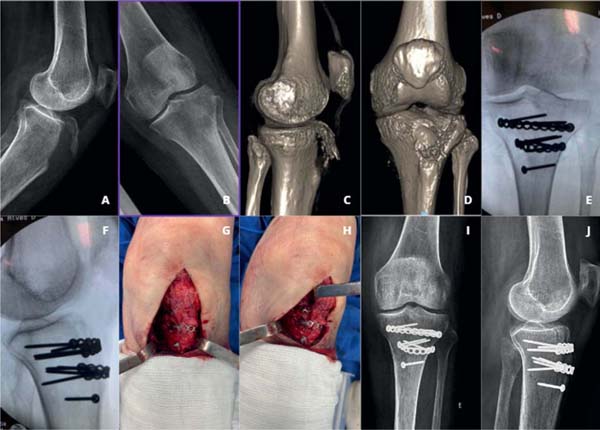
The second case refers to an 82-year-old female patient, with Alzheimer’s disease and osteoporosis, who was previously ambulatory with the aid of a cane, although with functional limitations. The patient sustained a fall with direct trauma to the left knee, resulting in ATT displacement and multifragmentation. A definitive surgical treatment with open reduction and internal fixation of the ATT, using 2 minifragment plates of 2.4 mm (Evos Mini Plating System, Smith & Nephew) positioned according to the tension band principle, conferring adequate stability and maintain reduction, as evidenced by fluoroscopic intraoperative evaluation. This case did not require transtendon passage of the plates through the patellar ligament. ►Fig. 2 illustrates the initial trauma and surgical treatment stages in patient 2.
As with patient 1, both plates were removed after fracture healing (3 months after fixation) to avoid additional injury from friction with the patellar ligament.
DISCUSSION
The available literature on the effectiveness and short-and long-term outcomes of different treatment methods for displaced and/or multifragmentary ATT fractures in adult patients is limited, consisting predominantly of case reports and small clinical series, without comparative studies or higher-level evidence.4,5 Limited data make it difficult to standardize management of these injuries and highlight the need for alternative strategies, capable of providing adequate stability, maintaining reduction, and promoting fracture healing in biomechanically challenging fractures. Using plates positioned horizontally in proximal tibial fractures is not a new concept.
Horizontal or semicircular plate configurations (barrel, hoop, or rim plates) have been proposed to treat complex proximal tibial fractures.4–7 Giordano et al.6 described the hoop plate as a method to contain the posterior perimeter in tibial plateau fractures, serving as a peripheral stabilizing element for posterior fragments. Similarly, Rojas et al.7 described the umbrella technique for complex proximal tibial fractures, combining an anterior hoop plate with an intramedullary nail to increase construct stability and contain the anterior perimeter during nail insertion.
Our technique follows a distinct biomechanical principle, functioning as a true tension band that “embraces” the multifragmentary ATT fracture and promotes dynamic containment of the fragments, even during knee flexion. The tension band concept is based on a classic biomechanical principle described by the AO Foundation, in which an implant placed on the tension side of a bone converts tensile forces into compressive forces at the fracture site during functional mobilization. In ATT fractures, knee flexion generates traction from the extensor mechanism, producing tensile forces at the proximal anterior cortex of the tibia. When a plate is positioned horizontally over the ATT, it acts as a tension-band device, neutralizing these forces and promoting dynamic compression at the fracture site during quadriceps contraction and knee motion.
This configuration may involve one or two plates, depending on fragment size and fixation requirements. Due to its low profile (2.0 or 2.4 mm), the plate may, when necessary, pass through the patellar ligament without significantly compromising the soft tissues, thereby expanding the technical possibilities in complex scenarios. To the best of our knowledge, no previous reports describe the use of horizontally positioned plates according to the tension band principle for fixation of ATT fractures.
This study has inherent design limitations. This is a technical note evaluating the efficacy of an alternative fixation method in only two patients, lacking a comparative group treated with conventional techniques. Long-term evaluation was not performed, and no functional scores or validated quality-of-life instruments were used. The small sample size also precludes an inferential statistical analysis, limiting interpretation to a descriptive analysis.Inbothcases herein reported, fixation with a horizontally-positioned plate following the tension band principle maintained reduction, provided adequate stability, and enabled fracture healing with no evidence of implant failure. These initial findings suggest that the technique may be a viable option in the therapeutic armamentarium and support the need for future studies with larger samples, longer follow-up, and comparative functional assessments to better define its indications and clinical outcomes.
FINAL CONSIDERATIONS
Fixation with a minifragment plate positioned horizontally according to the tension band principle proved to be a safe and effective alternative for treating complex and displaced ATT fractures in the two patients evaluated. The technique provided adequate mechanical stability to maintain reduction throughout follow-up, allowing satisfactory fracture healing.
REFERENCES